Macao is hosting the annual tech expo between 27 and 30 May, with talking points ranging from the challenges facing AI robotics to the internationalisation of Chinese tech
Physical AI takes centre stage at Beyond Expo 2026 in Macao
Article by:
PUBLISHED:

Beyond Expo, one of Asia’s leading tech and innovation exhibitions, returned to Macao for its 2026 edition yesterday, with the 4-day event scheduled to run at the Venetian until Saturday.
During the opening ceremony, Beyond Expo founder Jason Ho delivered an address in which spoke about this year’s agenda and theme, “AI: Digital to Physical.”
“We came here this week to do three things: explore the latest technology, innovate together, and network with the best minds in the industry,” Ho said. He introduced some of the new expo’s new offerings this year, including AI-enabled “one-person companies” (OPCs) that are joining the roughly 800 exhibitors.
Ho’s speech was followed by a number of talks on the topic of physical AI – a term used to refer to AI systems capable of perceiving and interacting with the physical world, in contrast to those that only inhabit a digital or software-based context.
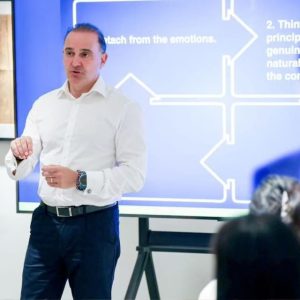
Deepu Talla, the vice president of Robotics and Edge AI at Nvidia delivered a keynote on the challenges of applying AI to robotics and physical AI, which he said stemmed from the “extremely high” accuracy requirements and lack of technology to overcome this threshold.
Talla noted that unlike digital AI, which receives human input and operates in a virtual environment with a high degree of accuracy, physical AI requires three computers – the computer to train the robot brain, the computer to test the robot brain in simulation, and the computer to deploy the AI in a physical robot.
“Until we hit that accuracy mark, whatever the task is, robots are not going to be very useful,” Talla said, noting that the most important challenge to solve in the field was the development of an accurate general purpose brain. He noted that once this was achieved, the scaling of physical AI robots would “absolutely happen, with “tens of billions of robots possible in the next 10 to 20 years.”
According to Talla, acquiring the necessary data to train, test and deploy robots is another major challenge.
Felix Zhang, the founder and CEO of the Shenzhen-based Pudu Robotics also spoke, taking part in a discussion in which he discussed his company’s development from a startup into a multi-billion dollar embodied AI business.
Zhang mentioned that when he first launched Pudu he wasn’t completely confident it would succeed, but embarked on the venture because of his passion for robotics, and a belief that focusing on business-to-business (B2B) products would achieve a higher rate of success, given his prior experience with the cutthroat environment of consumer products.
[See more: With Deepseek targeting a $50 billion valuation, here are the implications for AI’s spending binge]
Zhang also spoke about Pudu’s overseas expansion, recruitment strategies and product development, before ending his talk by giving suggestions on entrepreneurship. “Continuous growth is what matters in the long run,” he said. “Entrepreneurs must grow at a speed that is faster than ordinary people.”
Other speakers included Chi Xu, the CEO and founder of Xreal, who spoke about AI glasses and their significance to the shift towards physical AI. He predicted that AI glasses integrated with all-day personal AI agents were only two to three years away from becoming reality.
Xu also mentioned that Chinese tech firms needed to move from only exporting products to working with the global market to create value. He pointed out that an IPhone moment had not yet arrived for the smart glasses industry, but noted that Chinese firms were leading the way towards this milestone.
Talks were also delivered by Mark Nicholas Cutis, a senior advisor for strategic projects at the Abu Dhabi Investment Council (ADIC), and Matthew White, the global CTO of AI at the Linux Foundation.
The former pointed out that the council was “very focused on understanding AI,” although it wasn’t investing heavily in the sector yet. Nonetheless, he noted that the ADIC had researched 112 robotic companies in China and was looking to create a shortlist of 10 firms for investment.
Meanwhile, White that the gap between open AI models and closed AI models was reducing, with many of the innovations being copied quickly in the open platforms.
In terms of the future of open systems, White believed that they present an opportunity for people, especially students, to learn about AI systems and develop innovations, and maintained that closed and open systems would continue to co-exist.
“Open source democratises access and knowledge to these systems,” he said. “With Linux and Apache and other projects, folks get access to these tools and are able to experiment with them.”
This year’s Beyond Expo will feature over 220 sessions and talks from guests such as Morgan Samet, the managing partner and co-head of Lingotto Innovation Strategy; Christopher Oberder, the founder of LocalSend, who was recognised by Forbes 30 Under 30, and Cui Li, the chief development officer of ZTE corporation.