The data breach resulted in users’ names, telephone numbers and email addresses being leaked, although credit card details remained safe
Hong Kong cyberattacks: 1.3 million Urbtix users hit by data breach
Article by:
PUBLISHED:
Hong Kong cyberattacks are on the rise, as illustrated by two new local data breaches that have exposed the personal details of some 1.3 million users on the Urban Ticketing System (Urbtix) and several thousand people on the Hong Kong Arts Festival (HKAF) 2027 website.
Urbtix data breach
In a statement on 25 November 2026, Hong Kong’s Leisure and Cultural Services Department (LCSD) announced that the operator of its ticket booking platform Urbtix had reported “a hacking incident” the previous day.
Based on initial findings, the LCSD concluded that the leak resulted in the exposure of users’ personal data such as names, telephone numbers and email addresses. Other sensitive data did not appear to be breached, as the department noted that “the system does not collect information on users’ identity documents and masks credit card information.”
The LCSD said the contractor would compile a report on the incident after carrying out an investigation. Meanwhile, the department had also informed local law enforcement agencies of the matter.
Hong Kong Arts Festival 2027 website data breach
A similar data breach impacted the main website of the 55th HKAF on 23 November 2026, according to the Hong Kong Arts Festival Society in a statement on 25 November 2026.
The organisation said the several thousand users who bought advance tickets for the 55th HKAF may have had their customer details “unlawfully accessed.”
In response to the incident, the society said it had taken steps to prevent further security breaches on its website and would work with the authorities to investigate the attack.
What other major data breaches have occurred in the SAR in 2026?
The Urbtix and HKAF Hong Kong cyberattacks are among many online security incidents that have occurred in 2026.
One of the most serious incidents took place on 3 April 2026, when over 56,000 patients at the Kowloon East Cluster of hospitals saw their highly sensitive information, including names, gender, Hong Kong ID card numbers, hospital file numbers and surgical information, leaked on a third-party platform.
[See more: Hong Kong to build its largest home-grown AI data centre by 2030]
Other high-profile incidents in 2026 include an online attack against Hong Kong electrical appliance distributor Shun Hing Group that may have leaked the personal data of over 921,000 people, including around 1,000 staff and supplier personnel whose bank account numbers, salary details and ID card numbers were exposed.
Similarly, in May 2026, students and staff at four Hong Kong educational institutions saw their data leaked after hackers attacked the popular online learning management platform Canvas.
A government investigation later found that almost 147,000 people at the City University of Hong Kong had been impacted by the incident, with their names, emails, student IDs and enrolment information being compromised.
Why are Hong Kong cyberattacks growing?
Data breaches and other Hong Kong cyberattacks have been growing in recent years due to various factors. Police have noted that hackers normally take advantage of outdated and vulnerable systems. The Hong Kong Computer Emergency Response Team Coordination Centre (HKCERT) has also said AI technology has also made it easier to carry out such cyberattacks successfully.
Similarly, criminal organisations such as the triads have modernised, pivoting towards digital crimes such as scams and money laundering.
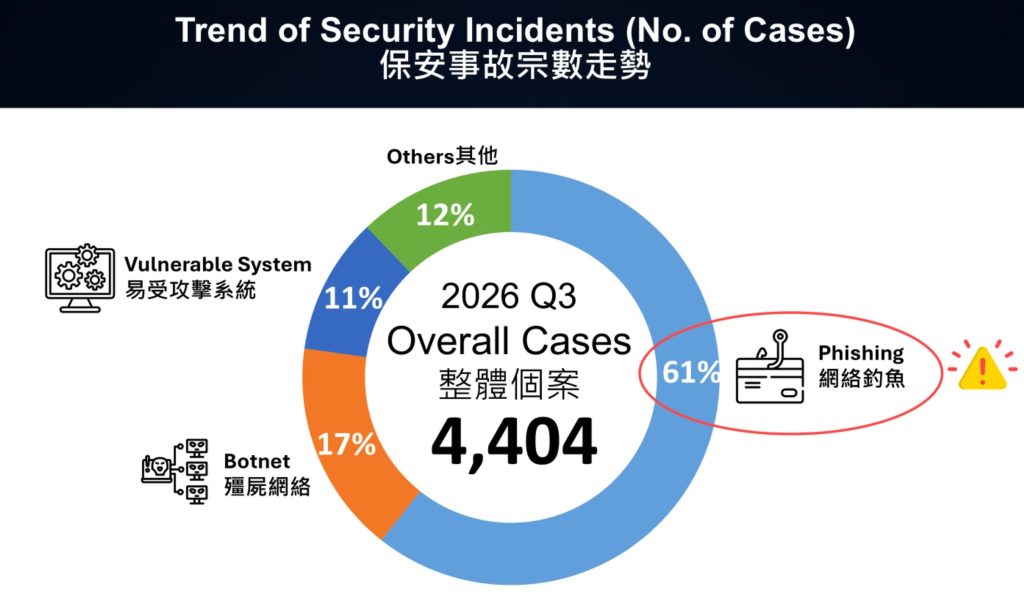
HKCERT data shows that there were 4,404 cybersecurity incidents in the city in the third quarter of 2026, up by around 15 percent (565 incidents) in comparison to the same period in 2025.
How is the government responding to the increasing number of cyber threats?
In light of the growing threat of cyberattacks, the Hong Kong government has implemented a number of measures to deal with the issue. On 1 January 2026, the Protection of Critical Infrastructures (Computer Systems) Ordinance came into operation, requiring designated operators of critical infrastructure to implement appropriate security measures and plans to respond to attacks.
Meanwhile, the government carried out its three-day 2026 cybersecurity attack and defence drill on 29 October 2026, with dozens of government departments, as well as public and private entities participating.
In addition, the Office of the Privacy Commissioner for Personal Data (PCPD) has formulated guidelines and recommendations aimed at reducing the risk of data breaches among local organisations.
UPDATED: 26 Nov 2026, 4:15 pm