Choosing the right school is a big decision for expatriate families. Here's a city-by-city guide to schools, fees and admissions
International Schools in China’s Greater Bay Area: 2026 Guide
Article by:
PUBLISHED:
For expatriate families contemplating relocation, the choice of international schools in China’s Greater Bay Area (GBA) is of vital importance.
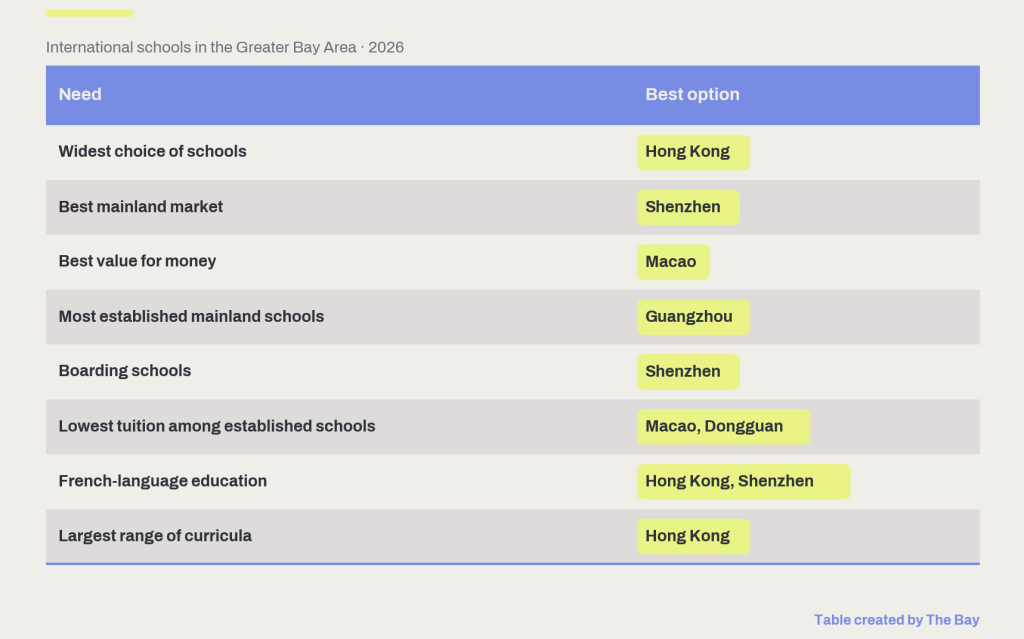
The challenge is that the region’s 11 cities offer vastly different levels of international education. Hong Kong has more than 50 international schools and virtually every major curriculum. Shenzhen and Guangzhou offer smaller but established markets, Macao provides lower-cost alternatives, but beyond those cities, the options narrow quickly.
[See more: The top 4 universities in the Greater Bay Area, ranked (2026)]
Just as importantly, many schools marketed as international, while perfectly reputable and in many cases excellent, are actually private schools for local students with international elements in the curriculum. Understanding that distinction can save families months of wasted applications, assuming that a genuinely foreign curriculum is being sought.
This guide explains where the schools for foreigners are, what they charge, and which cities offer the strongest options for international schools in China’s Greater Bay Area.
International schools in China’s Greater Bay Area: Which city is right?
International schools in China’s Greater Bay Area: key facts
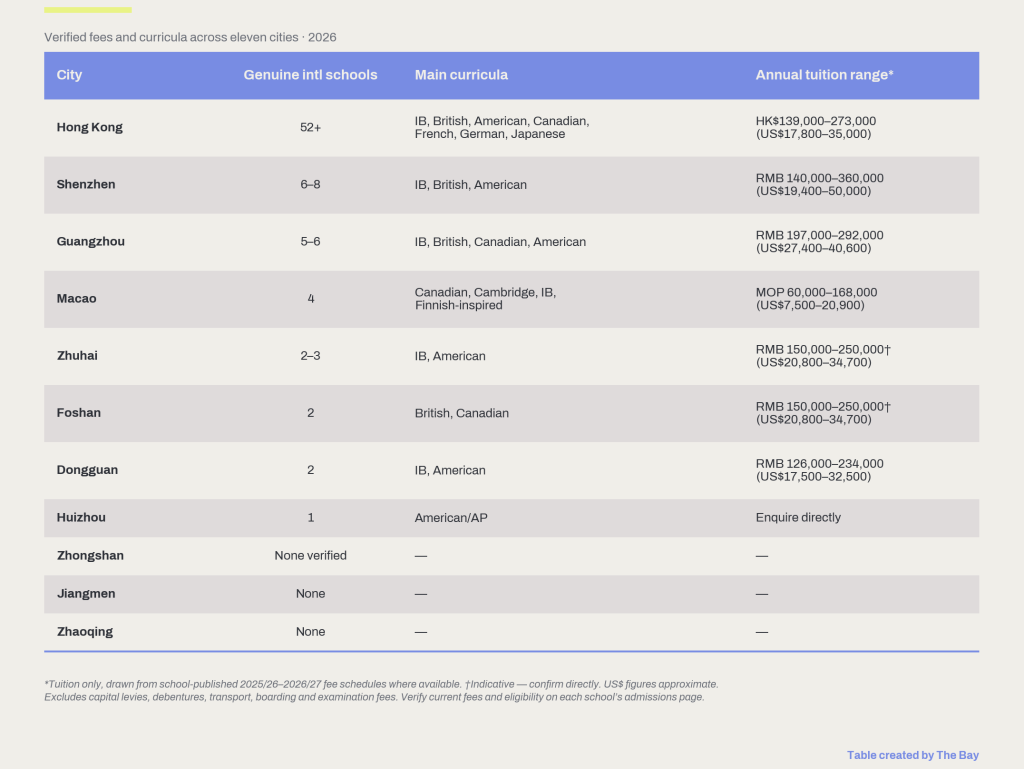
The most important question: Is it actually an international school?
Before comparing international schools in China’s Greater Bay Area, parents need to understand a distinction central to mainland China’s school system.
Schools for children of foreign nationals can generally enrol only foreign passport holders and residents of Hong Kong, Macao or Taiwan. QSI Shenzhen states the rule plainly on its admissions page: students holding only a PRC passport or ID card are not eligible. Alongside these schools sits a much larger group of bilingual private schools that carry international branding (including some of the region’s most famous British school names), follow elements of overseas curricula, and market themselves to expatriate families.
Many are excellent schools. But they differ in admissions rules and university pathways. A handful of special economic zones blur the line further: Harrow International School Shenzhen Qianhai, an international school by licence, also admits Chinese passport holders if a parent has worked in the Qianhai zone for more than 90 consecutive days.
Hong Kong and Macao operate under separate education systems, so local and foreign students alike can generally apply to international schools there, subject to admissions requirements and capacity.
For relocating families, verifying admissions eligibility on each school’s own page should be the first step in any search.
Hong Kong: The regional benchmark
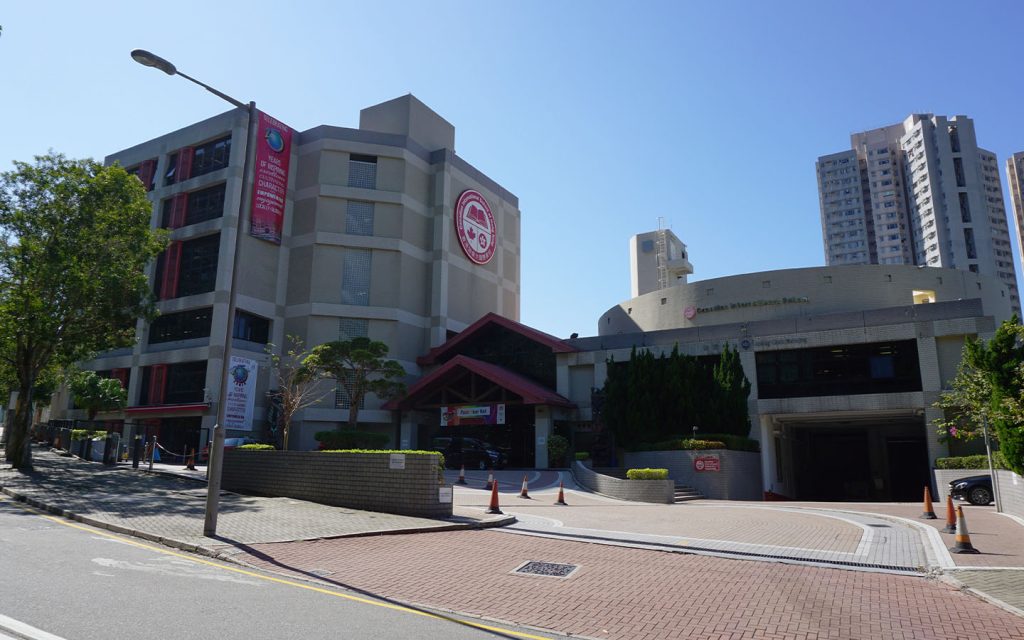
Hong Kong remains the Greater Bay Area’s strongest international-school market by a considerable margin. Its Education Bureau directory lists 52 international schools, plus a further tier of Private Independent Schools, covering every major curriculum a family is likely to want: British, American, Canadian, the full IB continuum, and dedicated French, German, Japanese and Korean pathways.
Some of the major names are Hong Kong International School (founded 1966), which follows an American programme with the territory’s broadest AP (advanced placement) catalogue. The English Schools Foundation runs a 22-school network of through-train IB schools, while the Chinese International School pairs the IB with English-Mandarin immersion and and the Canadian International School of Hong Kong is the only school outside Canada whose students graduate with both the IB Diploma and the Ontario Secondary School Diploma. The French International School and German Swiss International School meanwhile operate national-language streams.
The subsidised ESF schools run HK$139,000 (primary) to HK$181,100 (Years 7-10) for 2025/26, roughly US$17,800-23,200, while HKIS charges HK$272,600 (US$35,000) in Grades 9-12 for 2026/27 (published fee schedule), plus a HK$24,500 (US$3,100) annual capital levy. Optional debentures at some schools run into the millions of Hong Kong dollars, and expect waiting lists at the most sought-after names.
Hong Kong’s appeal extends past school: according to the QS World University Rankings 2027, the city is home to two of the world’s top 20 universities (HKU and CUHK), so families choosing a school here are also buying into a credible local higher-education pathway.
Shenzhen: The strongest mainland option
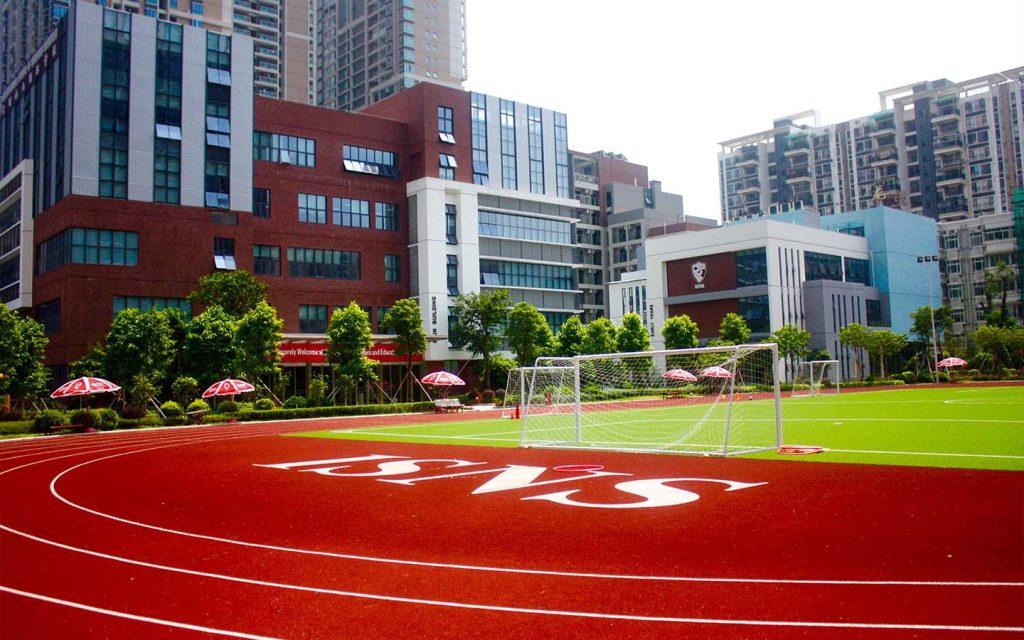
If Hong Kong is the regional benchmark, Shenzhen is the mainland leader. The city’s international-school sector has expanded rapidly alongside its rise as a technology and financial hub, and it now offers a strong mix of IB, British and American programmes – plus the region’s most developed boarding options.
The clearest choices for foreign families start with the International School of Nanshan Shenzhen (ISNS), which runs the full IB continuum from PYP to Diploma alongside a New Brunswick, Canada diploma route, and Shekou International School (SIS), the city’s oldest. Founded in 1988, Shekou is WASC-accredited, an IB Diploma World School, and home to a French Ministry-accredited programme. QSI International School of Shenzhen teaches an American curriculum with AP, with 2026/27 tuition of 140,400–255,600 yuan (US$19,500–35,500). Harrow International School Shenzhen Qianhai offers a British curriculum to IGCSE and A-Level with boarding, rare on the mainland; its 2025/26 fees run 291,400–360,300 yuan (US$40,500–50,000), plus 119,800 yuan (US$16,600) for boarders.
The Shenzhen College of International Education (SCIE), founded in 2003, is one of China’s strongest pathways to overseas universities – a highly selective Cambridge IGCSE/A-Level (and, since 2025, AP) day-and-boarding college – but it serves mainly Chinese students and is not an expatriate international school as such. The same applies to several British-branded boarding schools that admit Chinese nationals: Merchiston International School (British curriculum, open to Chinese students), the bilingual Bromsgrove School Mission Hills, and the separately licensed Harrow Hong Kong Children School Shenzhen Qianhai, which offers a Hong Kong (DSE) curriculum rather than a foreign international one.
Guangzhou: Mature but more limited
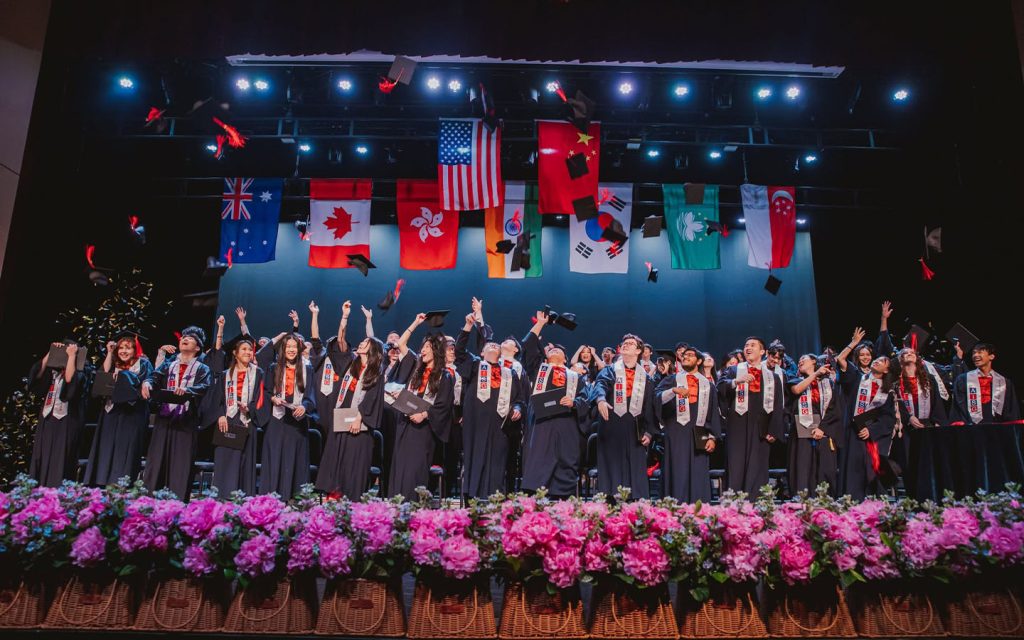
Guangzhou has one of southern China’s longest-established expatriate communities and is still an important international education centre.
The American International School of Guangzhou (AISG), founded in 1981 as an embassy school, was the first international school in southern mainland China and is the city’s only not-for-profit one. The Canadian International School of Guangzhou teaches the Alberta curriculum from kindergarten to Grade 12 – framed by the IB Primary Years Programme in the early years, with AP in high school – and its graduates earn the Alberta High School Diploma. The British School of Guangzhou, part of Nord Anglia, takes the English National Curriculum through to A-Level, with 2025/26 fees running roughly 220,000-292,000 yuan (US$30,600-40,600) from Reception to Year 13. There are also dedicated Japanese and Korean national schools.
Families should nonetheless expect fewer top-tier options than Shenzhen despite Guangzhou’s larger population, and should confirm enrolment rules at any partnership campus marketed locally – several follow the Chinese national curriculum. The market is solid, particularly for families seeking established schools and a stable expatriate community, but the breadth of choice is narrower than many newcomers expect.
Macao: The value option
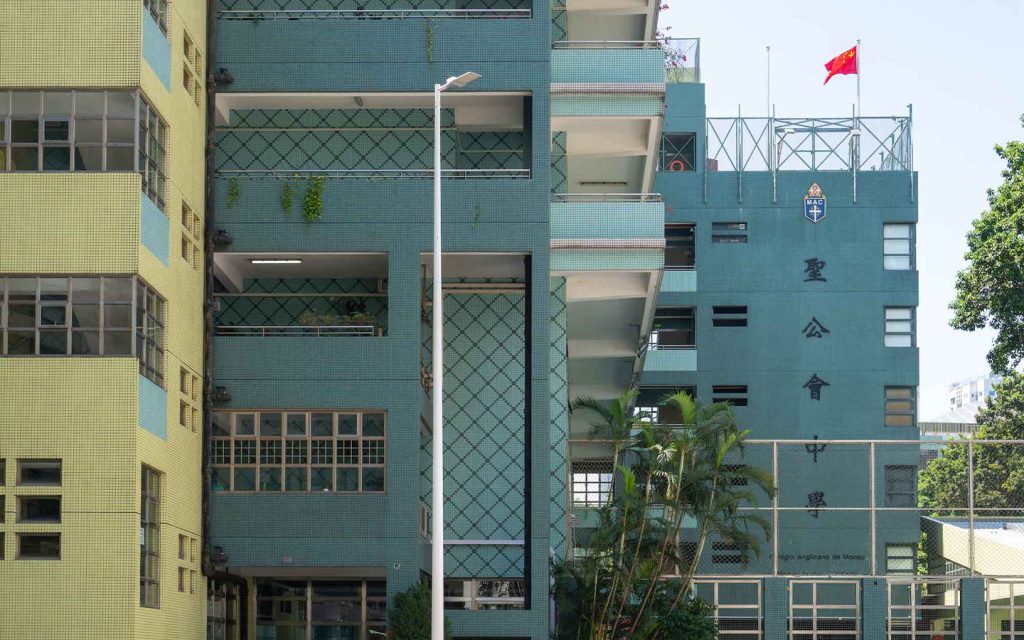
Macao’s international-school cluster is small – just four of the territory’s roughly 76 schools – but its fees are the lowest in the region.
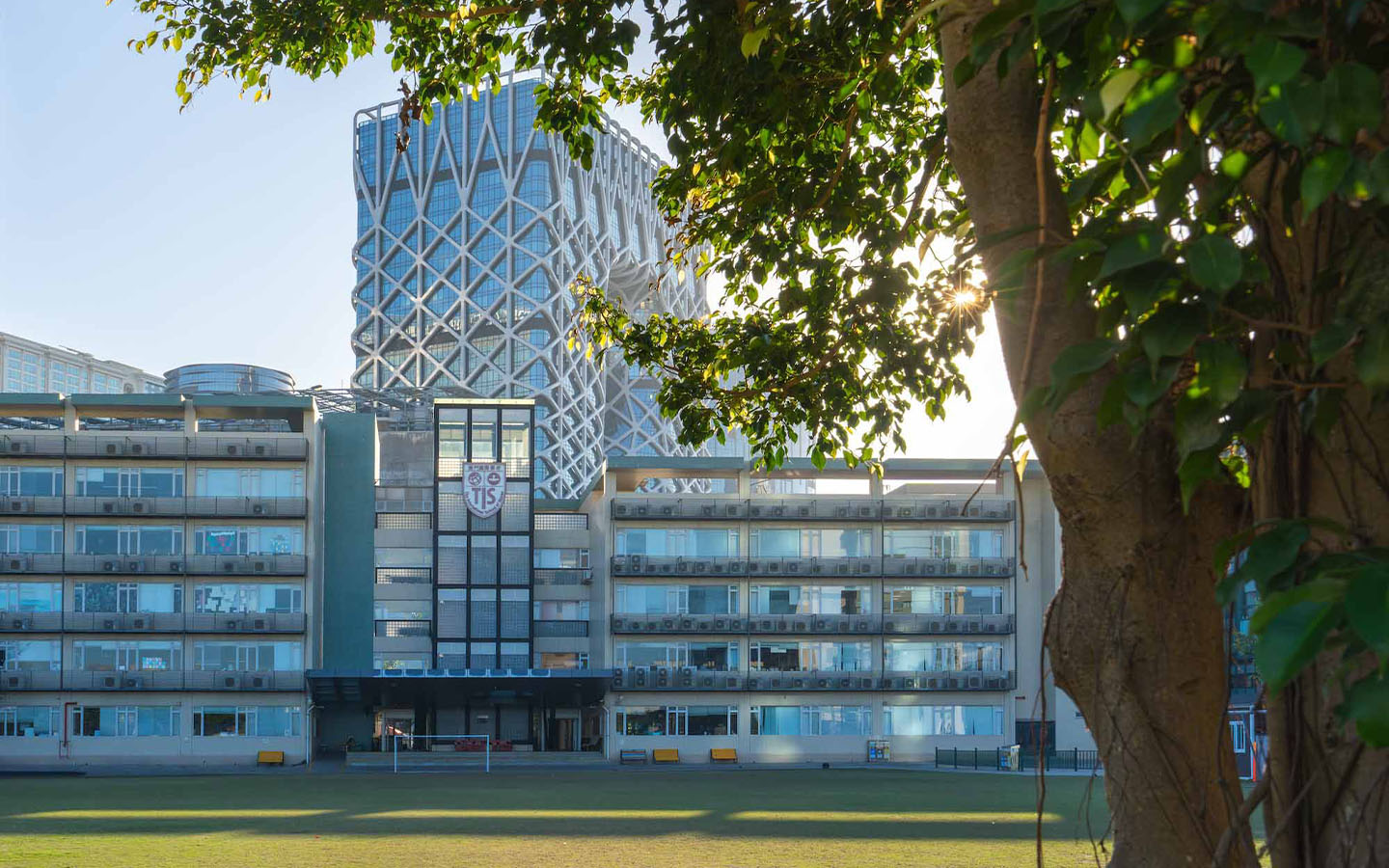
The International School of Macao (TIS) teaches the Canadian Alberta curriculum with an optional IB Diploma; Macau Anglican College follows a Cambridge pathway to IGCSE and A-Level; the School of the Nations opened in 1988 as a kindergarten and became an IB school only in 2009; and Generations International School, opened in 2023 in Coloane, offers a Finnish-inspired, trilingual English–Portuguese–Mandarin model and is still building out its upper grades.
Tuition is the lowest in the GBA, helped by government subventions for Macao ID holders. TIS, the most expensive of the four, publishes a 2026/27 schedule of 117,500 patacas (kindergarten) to 168,000 patacas (Grades 10-12), roughly US$14,600-20,900; the other three sit below that. The catch is choice: four schools rather than dozens, no boarding, and competitive placement that rewards early application.
Beyond the major markets
Outside Hong Kong, Shenzhen, Guangzhou and Macao, provision becomes much thinner.
Zhuhai offers a small cluster. QSI International School of Zhuhai (established 1999, the city’s oldest) is an American-curriculum, Middle States–accredited non-profit day school with AP in the upper years, while Zhuhai International School (ZIS), on Qi’ao Island, is a fully authorised IB World School offering the PYP, MYP and Diploma for ages 3–18. Harrow LiDe School Hengqin is a bilingual school for Chinese and overseas-Chinese students, not a school for foreign children.
Foshan’s market is young. Lady Eleanor Holles International School Foshan, which welcomed its first students in 2021, is a British day-and-boarding school for foreign children, linked to its 300-year-old UK namesake, teaching to IGCSE and A-Level for ages 8-18. The Canadian International School of Foshan teaches Alberta with A-Level options, but it is very new. Many expatriate families continue to look towards nearby Guangzhou.
Dongguan is anchored by the International School of Dongguan (ISD), the city’s first licensed international school – opened in 2012, WASC-accredited that December, IB Diploma–authorised in 2015. Its published 2025/26 tuition of 126,000–233,600 yuan (US$17,500–32,400) makes it among the more accessible genuine international schools in the GBA.
Huizhou’s primary option is BASIS International School Park Lane Harbour in the Daya Bay area – opened 2018, Grades 5-12, with substantial boarding – offering an American, AP-oriented programme. Note that BASIS-branded schools on the mainland draw heavily from Chinese families holding foreign documentation. Fees are not openly published; enquire directly.
Zhongshan, Jiangmen and Zhaoqing have no clearly verified international schools for foreign passport holders.
How to choose international schools in China’s Greater Bay Area
Start with the curriculum
The curriculum your child follows now, and the university system they’ll enter later, should drive the shortlist. The IB suits internationally mobile families; British IGCSE/A-Level points to the UK; American/AP aligns with US admissions; Canadian provincial programmes offer a balanced North American route. Hong Kong is the only GBA city where all are readily available.
Budget realistically
Tuition is only part of the cost. Parents should also budget for capital levies, debentures, school buses, uniforms, examination fees, extracurricular activities, school trips and boarding where applicable. At the top end, these extras can add 10-20 percent to the annual bill.
Think about the commute
In the Greater Bay Area, school location can matter as much as school quality. Cross-city journeys and border crossings can quickly turn into multi-hour daily commutes; families in Dongguan or Huizhou weighing a daily run into Shenzhen should test the route at peak hour before committing.
Check university outcomes
Ask schools where graduates actually enrolled, not simply where offers were received. University destinations – together with accreditation from the IB, the Council of International Schools, WASC or a recognised UK inspection – tell you more than any prospectus.
Apply early
The strongest schools operate waiting lists months or even years in advance, and the assessment process at the most competitive can run a full year ahead of enrolment.
UPDATED: 29 Jul 2026, 12:07 pm