The flood disaster – possibly triggered by a glacier collapse – hit the border of China and Nepal on the morning of 26 August 2026

Article by:
PUBLISHED:
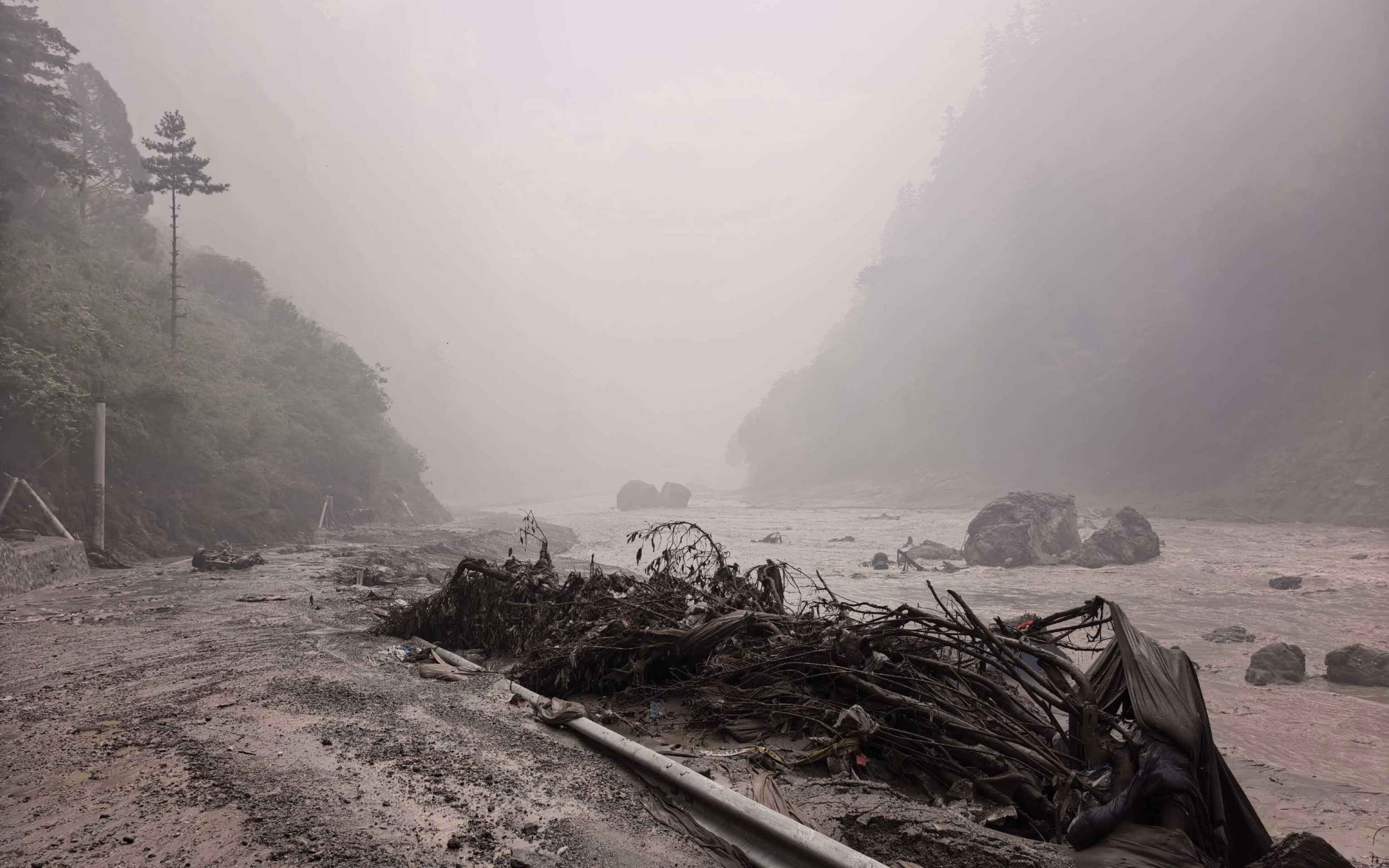
Massive landslides and floods have hit the border area between China and northern Nepal, resulting in at least 180 deaths and more than 1,300 missing.
According to Xinhua News Agency, the natural disaster struck Nepal at around 8:40 am Nepal time (10:30 am Beijing time) on 26 August 2026 before spreading to Gyirong county in the Tibet Autonomous Region, where it caused “massive casualties and missing persons.”
Dramatic footage from Tibet’s Gyirong Port shows a major landslide suddenly sweeping the land crossing, destroying vehicles and buildings and swallowing up evacuees.
As of 27 August 2026 (8 am), Gyirong county recorded an official death toll of 3 individuals, with 558 people still missing, including 260 foreigners. Meanwhile, the authorities successfully rescued 2 people from Gyirong county’s Resuo Village.
The Tibet-Nepal flood disaster has devastated Nepal’s border area, with Nepal’s Police confirming that there were 177 deaths, according to a Nepal News report published on 27 August 2026.
Of the 826 people reported missing by Nepal’s National Emergency Operation Centre on 27 August 2026, 466 were foreign tourists. Many of the missing tourists come from countries such as India, Ukraine, Malaysia, the UK, Canada, the US and Australia.
The high number of foreigners is due to the area being a popular route for accessing Nepal’s mountains and religious sites.
Earlier, the authorities also reported 85 security personnel and 162 local residents missing. So far, search and rescue crews have saved 104 people, as they continue locating missing individuals.
China’s Ministry of Emergency Management and National Fire and Rescue Administration have responded to the Tibet-Nepal flood disaster by dispatching 111 fire and rescue commanders and fighters from Beijing and Sichuan to the disaster zone. The workers are equipped with an array of search and rescue, telecommunication equipment, as well as breaching tools.
According to Xinhua Agency, Chinese President Xi Jinping was paying close attention to the disaster and said the main task was searching and rescuing missing persons by all means possible.
Xi also called for the evacuation of people at risk, the treatment of injured individuals, minimising the casualties and strengthening early warning alerts.
A number of causes have been cited for the devastation, with one possible one being a glacier collapse in the Himalayas, which eventually led to what the US Geological Survey (USGS) describes as “subsequent catastrophic impacts downstream.”
University of Dundee senior lecturer in energy environment and society, Simon Cook, told the BBC that climate change could have had a role in the disaster.
[See more: Typhoon Bavi disrupts transport and triggers mass evacuation in eastern China]
He noted that “permafrost is partially holding some mountainsides together, this permafrost is warming and thawing and degrading so you are going to get more landslides.”
A magnitude 4.4 earthquake was also initially cited as a probable cause, although the USGS later clarified that the seismic event, which registered a magnitude of 5.2, was from the landslide as opposed to an earthquake.
There has been an outpouring of grief from the international community following the Tibet-Nepal flood disaster. UN Secretary-General António Guterres, who was “saddened by the severe flooding,” said the UN would be offering resources and manpower to Nepal.
Narendra Modi, the prime minister of Nepal’s neighbour India, has pledged to offer the country “all possible humanitarian assistance.”
The US has also vowed to provide US$500,000 in relief, while UK Prime Minister Andy Burnham noted that his government would do all it could to support British nationals impacted by the disaster.