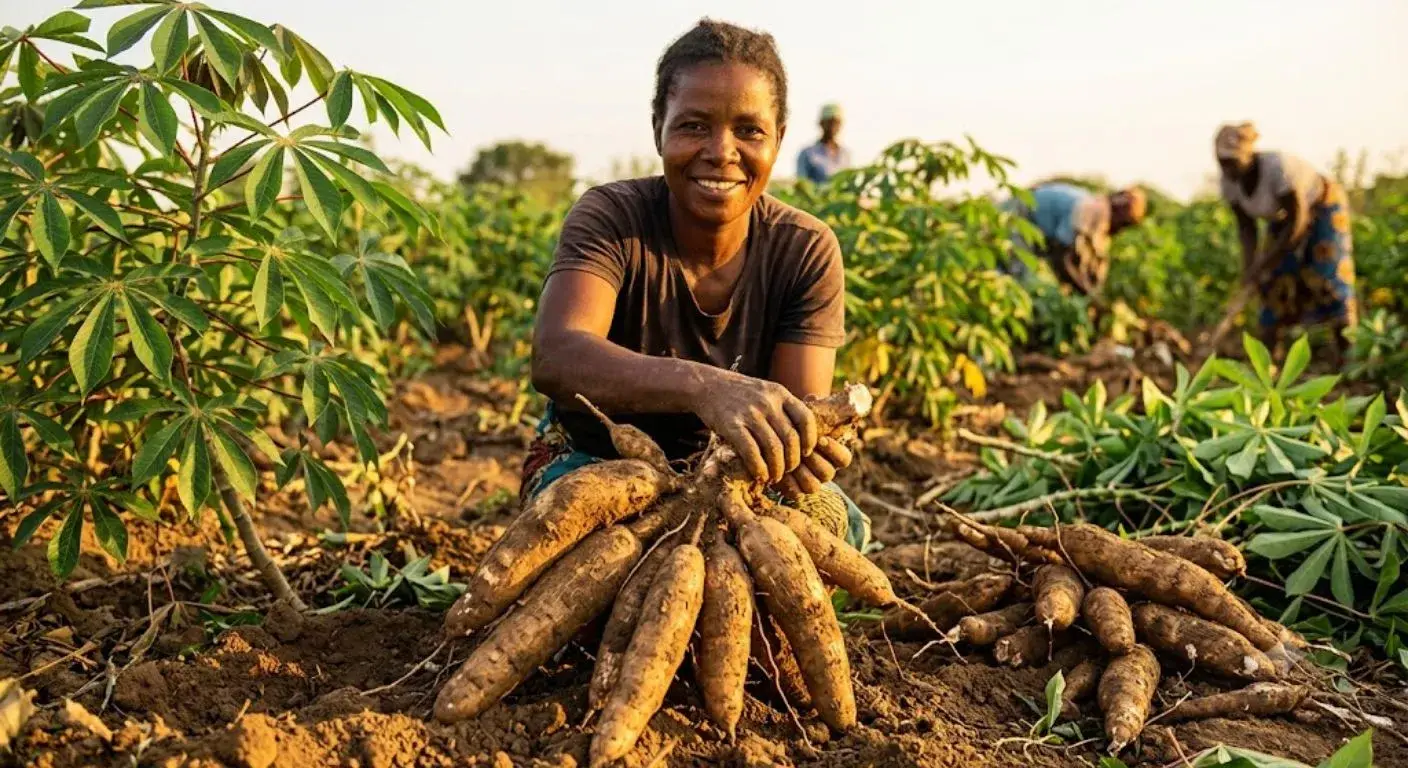
Mozambique cassava exports to China could transform local subsistence farming into a thriving export-oriented value chain.

Article by:
PUBLISHED:
Mozambique is preparing to boost agricultural production to supply overseas markets, with a new initiative centred on Mozambique cassava exports.
A memorandum of understanding signed recently in Maputo between the Chamber of Commerce of Mozambique and China’s Long Ran corporation establishes a framework to mobilise smallholder farmers, enhance cassava processing, and build an export-focused value chain. The development was reported by local news outlet Club of Mozambique.
Under the agreement, the Chinese group intends to purchase substantial volumes of Mozambican cassava for use in food, industrial processing, and animal feed. Additionally, the agreement highlights Gaza province in the south as an area with strong potential for large-scale, export-oriented cultivation. Although exact quantities, financial investments, and export schedules have not yet been disclosed, the initiative marks a significant step forward for the region, the report said.
According to figures from United Nations food agencies, Mozambique currently produces roughly 7.5 million to 8.5 million tonnes of cassava annually. The vast majority of this yield is cultivated by smallholder farmers for local consumption. While production is distributed across several regions, cassava serves as a vital staple food and essential food-security crop primarily in northern and central Mozambique.
China remains one of the largest global importers of cassava products, particularly dried chips and pellets, which are heavily utilised in animal feed production, starch manufacturing, and ethanol creation.
Historically, China has sourced the majority of these imports from established Asian suppliers such as Vietnam, Thailand, and Cambodia. Consequently, this new partnership could successfully open an alternative trade route for a Mozambican crop that has traditionally been widely cultivated but only weakly traded on the international stage.
[See more: Mozambique ruby production surges in first half of 2026]
A representative for Long Ran told media that the corporate group aims to elevate Mozambican cassava into a globally recognised product. Beyond direct human consumption, cassava roots can be transformed into flour, starch, and tapioca. Furthermore, dried chips and pellets are instrumental in alcohol and ethanol production, while cassava starch serves important functions across the paper, textile, adhesive, pharmaceutical, confectionery, and food processing industries.
Lucas Chachine, president of the Chamber of Commerce of Mozambique, emphasised that a reliable, guaranteed market will provide smallholders with the confidence needed to expand beyond basic subsistence farming. Producers will recognise that their operational limit is no longer restricted to direct local consumption, giving them a dependable avenue to generate consistent household income and stimulate regional economies.
Although Mozambique has not historically been recognised as a major global exporter of the crop – with only minor formal exports destined for South Africa and informal cross-border sales reaching Malawi – this new agreement could successfully convert a primary subsistence crop into a lucrative source of international export revenue.