Nearly a fifth of the accumulated debt floated in Macao has been classified as green bonds, attracting issuers from across the GBA.
Here’s how Macao is supporting the GBA’s environmental initiatives
Article by:
PUBLISHED:
Amid the national mandate to decarbonise China’s economy, Macao’s nascent green bond market is picking up steam. The total accumulated green debt raised in the Macao Special Administrative Region (MSAR) reached 204 billion patacas (US$25.5 billion) at the end of August, a 27-billion-pataca increase since the start of the year according to data from Chongwa (Macao) Financial Asset Exchange (MOX) analysed by The Bay.
That 15 percent year-to-date growth has outpaced the 9 percent increase in total accumulated debt, which now stands at nearly 1.2 trillion patacas. Macao’s foray into the fixed-income space dovetails with broader regional efforts to diversify the economy, but leveraging its offshore credit market to draw climate-related issuances from around the GBA is becoming a more distinctive feature.
[See more: Report reveals significant progress in China’s greenhouse gas targets]
A solid track record is emerging. For the sixth consecutive year, the Guangdong provincial government floated offshore debt in Macao in a late August deal worth 2.5 billion yuan, which included 1.5 billion yuan in green and 500 million yuan in blue securities. Just a few weeks later, the Shenzhen municipal government issued 1 billion yuan in offshore paper, representing its second consecutive deal in the MSAR but also the first issuance of a GBA themed sustainable bond in a city better known for casinos and tourism traffic.
Macao accounts for a small share of the regional fixed-income market, often overshadowed by major GBA hubs like Shenzhen which routinely generate tens of billions in onshore debt within a matter of months. But what’s on display is a tightening collaboration across nine mainland cities and two SARs to nurture a green and sustainable finance market to channel long-term capital into areas addressing climate-related risks.
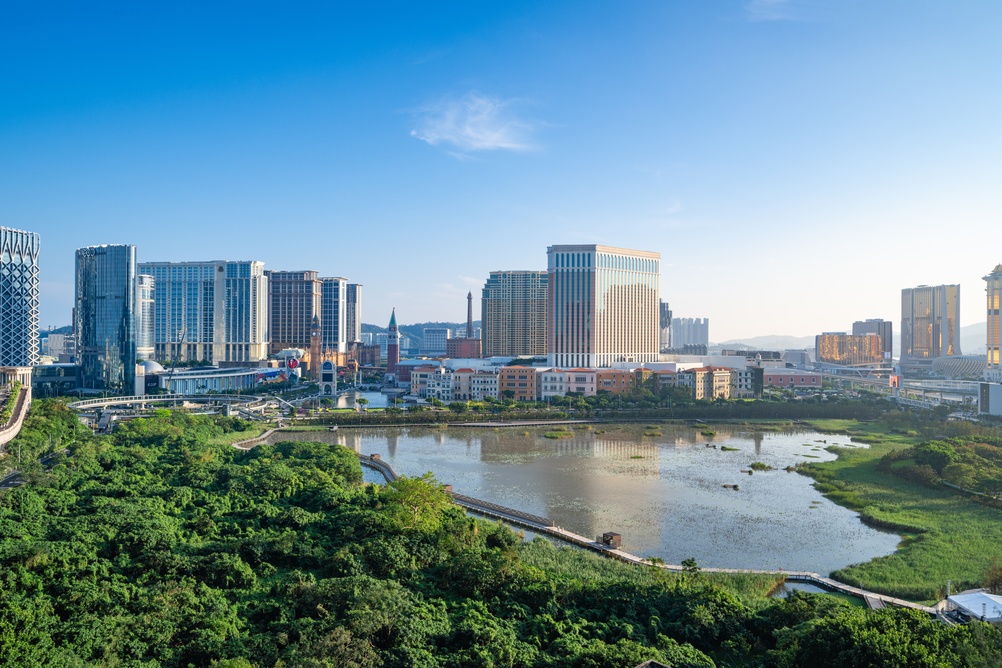
Cross-border support is becoming more visible. During September’s Hong Kong Green Finance Association’s (HKGFA) annual forum, mainland and SAR officials officially launched the Green Accelerator, a non-profit platform bridging capital to early-stage green tech projects.
Just days later, the Hong Kong Monetary Authority (HKMA) broadened its definition of sustainable finance taxonomy while HKSAR’s inaugural five-year plan set out a framework to integrate green transformation targets alongside national development goals, one that entails raising the city’s clean energy share up to 70 percent of the fuel mix by 2035.
“The call to action tackles common hurdles that have undermined previous sustainability efforts, like green premiums, liquidity fragmentation, and green-washing risks,” commented Basel Kirmani, founder and general manager of Turquoise Sustainability, a Hong Kong-based consultancy.
By clearly defining economic activities that contribute to green and sustainable development, the taxonomy updates establish a credible assessment tool for informed decision making that scales up relevant capital flows to compound the GBA’s decarbonisation effort, Kirmani explains to The Bay.
Back in the SARs
The emphasis on interoperability with major regional and international taxonomies enhances the comparability of sustainable finance classifications, analysts at Moody’s Ratings write, adding that Hong Kong’s policy stance signals enduring backing to uphold a local sustainable finance market.
But while sustainability advocates expect both SARs to leverage their debt markets to raise sizable green capital, Hong Kong will still drive the heavy lifting. Total green and sustainable debt instruments issued in Hong Kong exceeded US$76 billion in 2025, accounting for 40 percent of the region’s total issuance in Asia, according to the HKMA, highlighting the capability gap between itself and Macao.
Besides Hong Kong’s deeper capital market, which often translates to more competitive funding costs, its English common law framework is the preferred legal structure among global investors, leaving Macao’s civil law as a complementary regime for niche issuances, particularly those from Portuguese-speaking countries.
[See more: Hong Kong reinforces its role in GBA green finance at annual forum]
“Though a domiciled jurisdiction like Luxembourg demonstrates that investors are not opposed to civil law alternatives, that framework does not carry distinct advantages even when definitions surrounding environmental, social and governance (ESG) terminology can be more crucial,” says Eduardo Loureiro, a Macao-based international lawyer and arbitrator.
Without a cost or regulatory advantage, Macao is unlikely to narrow the issuance gap with Hong Kong because demand beyond Portuguese-speaking countries (PSCs) remains limited. For non-Lusophone issuers, choosing Macao requires a concrete commercial or policy benefit, rather than a general ESG rationale or a desire to support regional economic diversification, Loureiro explained.
Maritime matters
Yet, within this niche, opportunities exist. Blue bonds have emerged as a promising asset class within sustainable finance that utilises Macao’s luso ties. Valued at $3 trillion, the blue economy impacts the livelihood of 3 billion people particularly in the Global South, which accounts for a handful of Portuguese-speaking countries.
GBA issuers have taken the lead here. Back in 2020, the Bank of China’s Macao branch issued Asia’s first blue bond, raising 3 billion yuan in offshore debt while the Guangdong provincial government has raised a total of 1 billion in offshore yuan in blue bonds over the past two years with proceeds used to sustain maritime and ocean resources.
[See more: China outlines new targets for ecological protection by 2030]
Locally, experts note strong policy tailwinds in Macao to mitigate climate related risks as weather related disruptions are becoming increasingly costly. Flooding caused by super typhoons in 2018 and 2025 closed the city’s casinos for more than 30 hours, prompting an economic loss of nearly 1 billion patacas each time.
Though the 11-city GBA is still bounded by three jurisdictions, addressing interoperable standards and frameworks to mobilise public and private climate capital has transcended those administrative borders. With policymakers matching the national carbon peaking target of 2030, how Macao defines its contribution to the region’s environmental initiatives becomes an early bellwether of the gaming economy’s ambition to not only diversify its structural drivers, but also an indication of how the GBA approaches overlapping challenges.