Raymond Tam says that areas have been set aside at Macao’s Hengqin and Jockey Club LRT stations for extensions to Hengqin’s future light rail stations
Macao’s transport secretary shares plans to link LRT with Hengqin
Article by:
PUBLISHED:

Macao’s secretary for transport and public works, Raymond Tam, has shared new details concerning a plan to connect the local Light Rapid Transit (LRT) network to a light rail system that is under development in Hengqin – an island district of Zhuhai.
At a Legislative Assembly session reported by media yesterday, Tam said the government had already reserved areas at Macao’s Hengqin and Jockey Club LRT stations, in order to allow for them to be linked to the future Hengqin light rail’s L1 and L2 lines.
The transport secretary also revealed that a connection between Barra Station and the proposed Hengqin LRT was being planned in the long term.
He pointed out the SAR government was hoping to establish a seamless railway connection between Macao and Hengqin, so as to align with China’s high-speed railway development and allow for Macao and Hengqin to reap the benefits.
On the choice to implement further extensions to the Jockey Club Station, Tam described the facility as “a relatively well-equipped station capable of handling passenger flows.” He noted that the Jockey Club Station would serve as a transport hub in the future, acting as a transfer point with the future Taipa Central Line.
The government has similar plans for the Barra Line, which it hopes will become a transport hub connecting the current Taipa Line to the proposed South and West Lines.
[See more: Over a million people regularly commute between Guangzhou and neighbouring cities]
Regarding the South Line, Tam said its construction would be “our top priority,” adding that the authorities were “striving to get the project off the ground as soon as possible.”
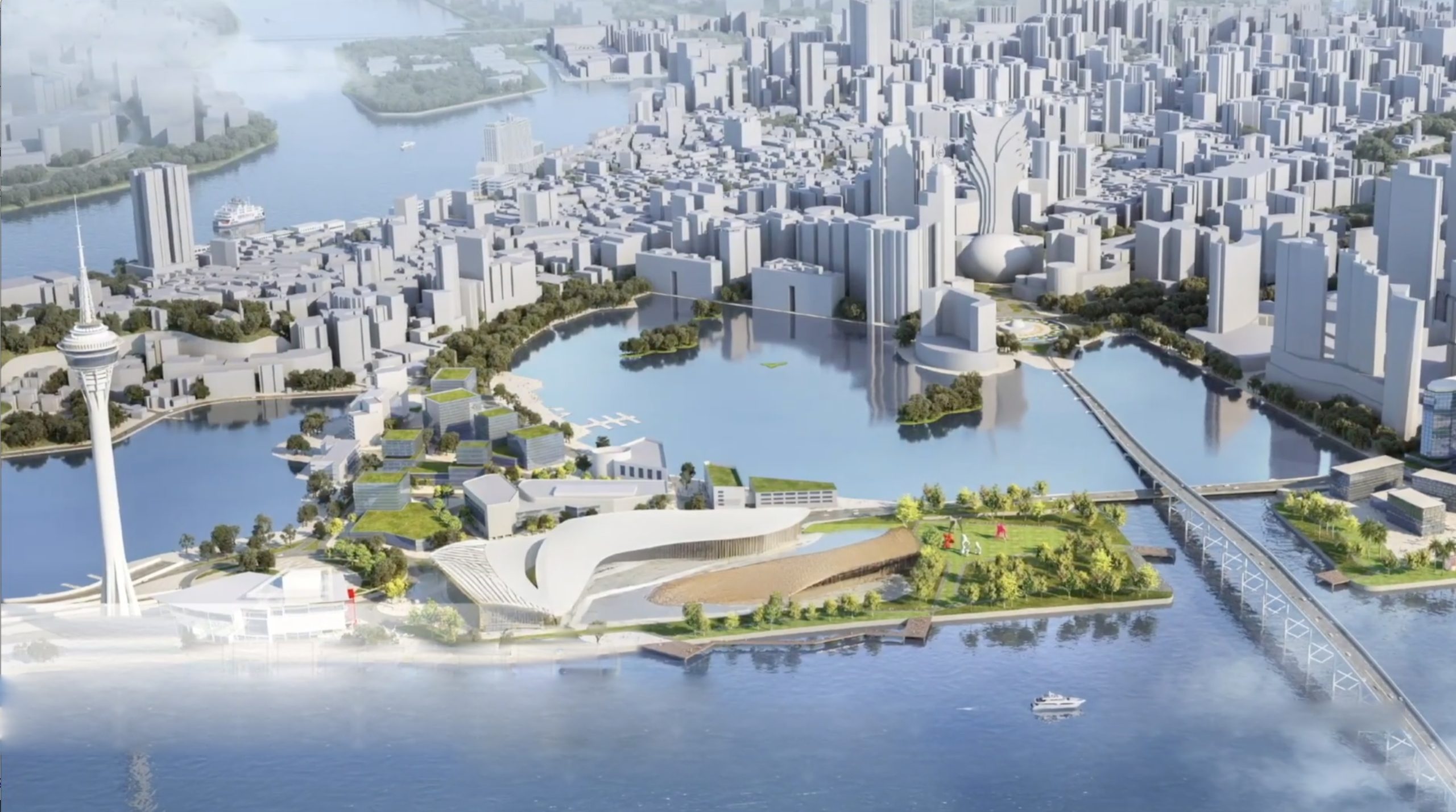
He explained the route was “of vital importance,” as it serves as the first step to linking up the various border crossings in Macao, traversing through key areas such as the southern end of Zone A, the Science Museum, the NAPE district, Nam Van Lake, Sai Van and Barra.
Tam also revealed the government was working to introduce QR code payment for the LRT fare via the Greater Bay Area’s major e-wallet platforms. The plan is to complete the development of the system and begin the gradual installation of the new turnstiles and self-service payment machines by the third quarter of this year.
Mention was made of the East LRT Line – a route under construction that will run between the Border Gate, Urban Zone A, Urban Zone E and the Taipa Ferry Terminal. Tam stated that LRT passenger numbers are expected to rise noticeably once the East Line launches in 2029.
A potential fifth cross-sea link connecting the NAPE district to Urban Zone D was discussed as well. Tam said the project was still in the research stage, noting that a dynamic assessment of the changes to the Macao Bridge’s traffic flow would take place after the opening of the Taipa Grande Tunnel in 2029, which is expected to boost usage of the bridge.
The secretary, however, stressed that construction of a fifth link would not take place simply for the sake of construction. Should the tunnel be built, the top deck would be used for vehicular access, while a lower deck would be reserved for an LRT route that provides access to the proposed Taipa Central Line and Taipa Northern Line.