Macao government self-service kiosks can now be used to access public services across 12 locations
Macao government self-service kiosks expanded to Shenzhen, Foshan and Dongguan
Article by:
PUBLISHED:
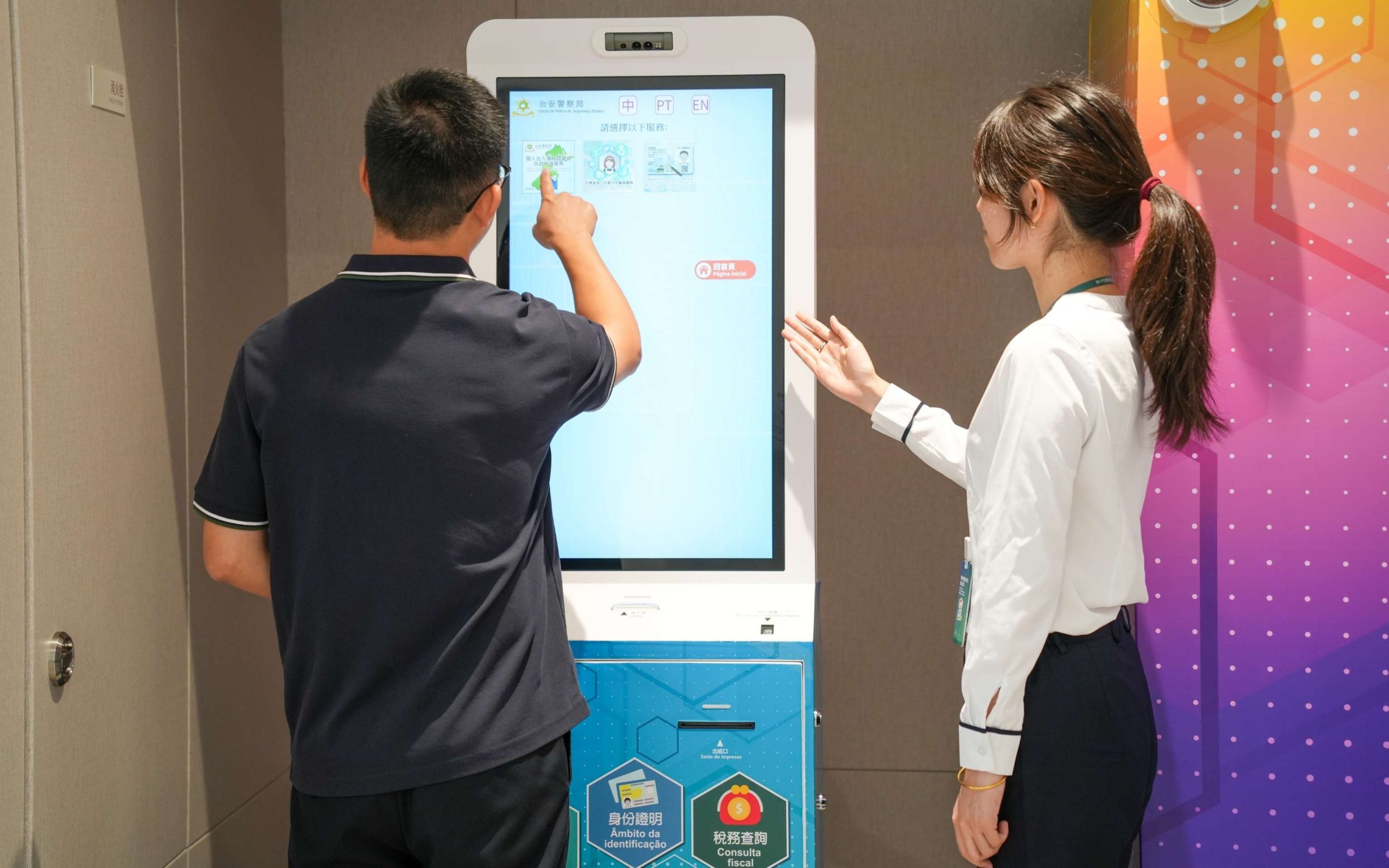
Authorities in Guangdong and Macao have expanded the number of Greater Bay Area (GBA) locations housing Macao government self-service kiosks from seven to twelve, making it easier for people from Macao living in mainland China to access Macao public services.
The expansion introduces the digital terminals, whose name can be translated from the Chinese as Macao Government Services Easy, to five new locations. They include the government service centres in Shenzhen, Foshan, Dongguan, Zhongshan’s Tanzhou town and Zhongshan’s Sanxiang town.
Previously, Macao government self-service kiosks were only available in Hong Kong, Guangzhou, Zhuhai, Zhongshan, Jiangmen, Hengqin Port and the Enterprise and Talent Service Centre in Hengqin.
For the full list of the kiosk locations, visit the Identification Services Bureau’s dedicated page here.
How will Macao residents benefit?
Increasing the number of Macao government self-service kiosks is expected to greatly benefit people from Macao living in the mainland, as it allows them to carry out services without needing to travel back to Macao.
“Before I had to return to Macao to conduct the relevant administrative matters,” a Shenzhen-based Macao entrepreneur identified by the surname Chan, said to Nanfang Daily. “Now I can easily carry out the process in Shenzhen, which is really convenient.”
[See more: What is China’s Greater Bay Area (GBA)? A simple guide]
As well, Macao people residing in the mainland are not required to return to Macao to collect their documents, as they can access soft copies via the Macao One Account platform, or delegate a family or friend to collect the document from a designated location in Macao or Hengqin on their behalf.
During a launch ceremony for the Macao government self-service kiosks expansion on 20 August 2026, Dong Zhichen, a representative of the Guangdong Provincial Administration of Government Service and Data, described the broadened coverage as holding “great significance.”
He noted that the measure demonstrates deepening strategic cooperation between Guangdong and Macao and mutual consensus within the GBA. At the same time, it was also an exploration of administrative integration in the region.
What services do the Macao government self-service kiosks provide?
Currently, the Macao Government Services Easy machines offer 38 types of Macao government services across 11 public departments, covering seven key areas such as social welfare, proof of identity, tax inquiry, municipal services, voter registration, transport and border crossings.
Responding to public demand, the government has added more ID document-related services to the self-service kiosks, allowing residents to apply for documents such as their Certificate of Personal Data, Certificate of Kinship and Certificate of Existence of Registration Record of Established Association or Foundation.
What’s the future plan for the Macao government self-service kiosks?
Speaking to Nanfang Daily at the launch ceremony, Chan Hoi Fan, the director of the Identification Services Bureau, said that the Macao government self-service kiosks had been used some 1,000 times since they were first launched in the GBA’s four cities on 30 June 2025.
She stated that the initiative now covers eight cities, two towns and Hengqin, with the government hoping to eventually have the kiosks located across all GBA cities.
How else has Macao been integrating with the rest of the GBA?
The Macao government self-service kiosks are only one of many measures that have been implemented in recent years to bring Macao closer with the rest of the GBA. The Zhuhai island district of Hengqin has been a particularly important testing ground for integration measures.
Some prominent examples include Hengqin’s Macao New Neighbourhood housing project, which allows SAR locals to move into a housing development designed to resemble those in Macao. Similarly, registered single-plate Macao vehicles have been able to cross into Hengqin since 2016, with the government planning to allow eligible vehicles to enter the rest of Guangdong in the foreseeable future via a reservation system.
As well, Macao has been working hand-in-hand with other GBA cities in various areas such as business and tourism. On 12 August 2026, the city held a joint event with Guangdong and Hong Kong in Malaysia to promote multi-destination travel in the GBA.