O'Hara leads one of China’s top education travel companies, working with schools to provide cultural experiential programs to students
Morgan O’Hara: from study tour student to cultural entrepreneur
Article by:
PUBLISHED:
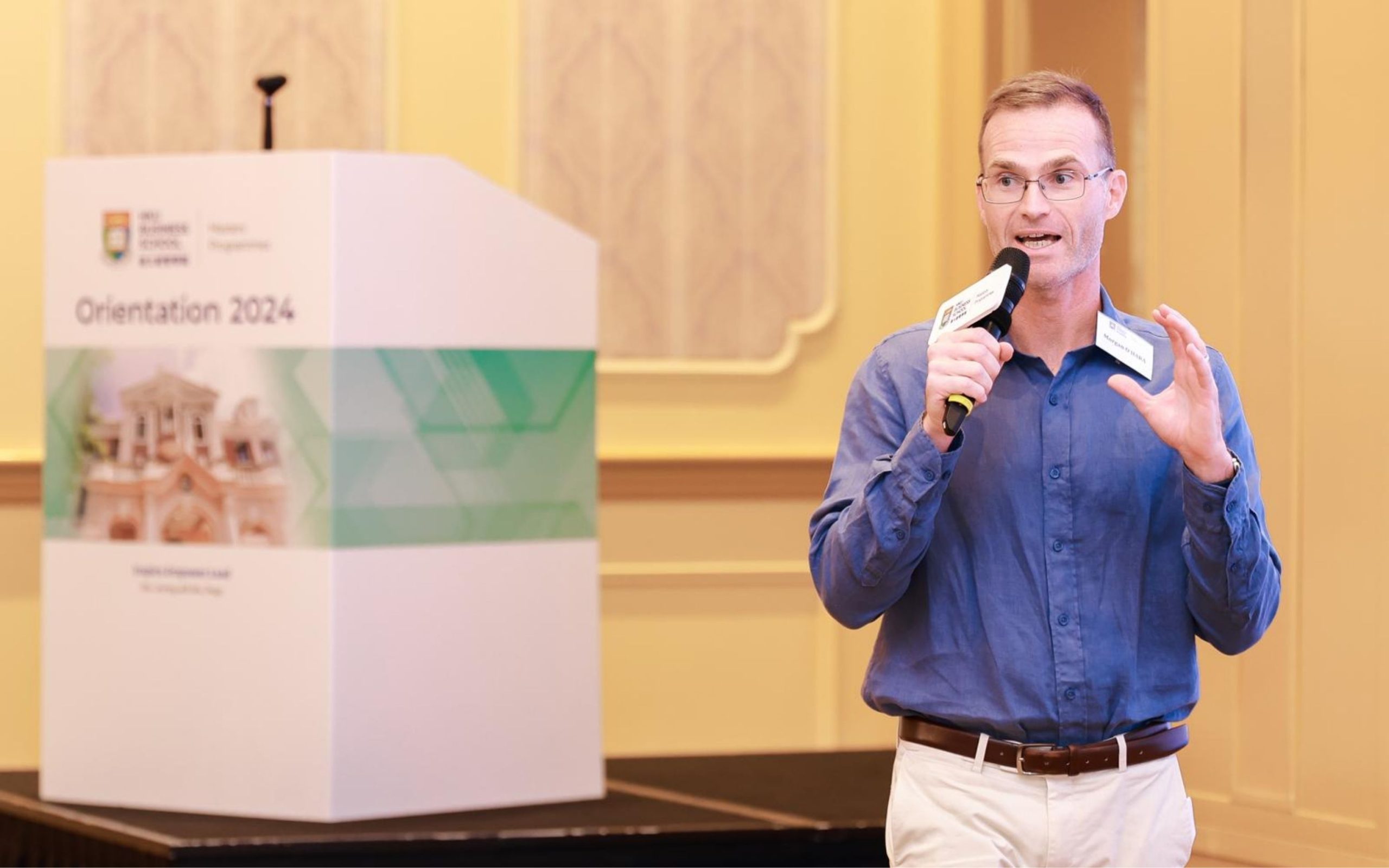
Morgan O’Hara’s entrepreneurial journey in China is unconventional by most standards. When the New York native first stepped foot in Beijing in the summer of 2008, he was simply embarking on a graduation study trip as an MBA student at California Polytechnic State University, with no plans to start his own business overseas.
As it happened, O’Hara visited The Hutong, a cultural exchange centre located in one of Beijing’s many disappearing hutong courtyards, which had been founded a year earlier by Australian entrepreneurs – Mark Thirlwall and Stacey Shine.
The trio immediately hit it off, so much so that O’Hara was later offered a role as the general manager and marketing director. As the American recalls, “when I first started, the focus was really on getting our hutong courtyard humming and buzzing and trying to get us to be the talk of town.”
[See more: GBA Voices: Macao architect Christine Choi on doing business in the Greater Bay Area]
However, O’Hara and his business partners quickly realised that the centre’s limited courtyard space was constraining its growth, leading them to seek more opportunities further afield. This came in the form of cultural experiential programs, which the company ran for Beijing-based international schools across domestic locations such as the northern hills of Beijing and Inner Mongolia.
In the 18 years since, The Hutong has developed into one of Greater China’s leading experiential education travel companies, with around 100 freelance staff during peak periods and 52 full-time employees currently spread across Beijing, Shanghai, Hong Kong, Taiwan and Thailand. This year, over 13,000 students are set to join the company’s various programmes.
Meanwhile, O’Hara has become The Hutong’s managing partner and its largest shareholder.
The Bay spoke to O’Hara, who is a member of the Greater Bay Area (GBA) chapter of Entrepreneurs’ Organization (EO) – a non-profit network aimed at facilitating growth and creativity among its members – to learn more about his company and doing business in the GBA.
This interview has been edited for brevity and clarity.
How big is the GBA market for The Hutong?
Hong Kong is our biggest market by far. We work with lots of schools in Hong Kong. You could say the GBA is probably generating about 50 percent of our business revenue.
What strategies did you adopt to scale The Hutong?
I joined a workshop run by a guy named Verne Harnish [at the Beijing chapter of EO]. At the time, he had a system. Now it’s called “Scaling Up,” but it used to be called “Mastering the Rockefeller Habits,” and it was all about how you can grow, scale and expand your business. There are particular choke points or rhythms that you can institute or implement in your business, and it just clicked with me, and I was like, “Oh, this is kind of a blueprint for us.”
I would say another thing that has allowed us to expand is we’re very much a people-centric organisation. We very much value company culture and a lot of our expansion has, of course, been for business reasons, but a lot of it’s just been also personal. We want to provide opportunities for our teams. That’s how we opened up our Taiwan, Hong Kong and Thailand offices.
How would you describe the international school and education travel business in the GBA?
In terms of international schools, there’s a lot more, I would say, competition in mainland China because there was such a massive amount of expansion and investment that was then hit by regulation. That impacted the way a lot of international schools operate and got funding. There was over-investment and I think Chinese parents are very discerning. I think a lot of top-tier schools won’t have issues, but a lot of those mid-tier schools are struggling more.
I think with experiential education, there’s more of a realisation [of its value]. Previously within China, there was a lot more scepticism about the value of getting outside of the classroom. It was more about grades and making best use of technology. Parents now realise that their kids need to take a step back from screens.
[See more: GBA Voices: Meet David McCann, the CEO of AOP Capital]
There was a study I saw which actually looked at both Western and Chinese parents and what they are looking for within their kids and what they’re most worried about. The one thing which both Western and Chinese parents were aligned on was the need for their kids to develop more grit, resilience and independence.
I think education is moving a bit more in that direction, especially with the rise of AI, teaching kids how to think is really important, and that’s a big part of school and what experiential education is about.
Has the rise of AI affected The Hutong’s business model?
I feel really good about our business because even though we’re not going to scale into a massive company, we’re not going to be taken over by AI. We’re in the business of providing experiences. You need people to be able to deliver that and do a really good job to deliver a high-quality experience.
We feel in some way protected from AI, but we know that we need to be able to use AI as an organisation to improve how we operate. There’s a couple of things we’re doing now. One, we’re coming up with AI guidelines. We want to set up guidelines and say for each department or for each person within the team, ‘here are the things you should be using AI for at a base level that are going to make your job easier, that are going to save you time and that we can all do and buy into.’
We’ve set up a Claude teams account for [six team members] to look at experimenting with how to incorporate AI into different processes, what are some of the high leverage projects that we can do and potentially roll those out.
In your work with international schools in the GBA, do you notice any major differences in the way they operate?
Each school has a unique culture. I don’t know that there would be a difference between a school in Guangzhou versus a school in Hong Kong. I would say it’s more based on the schools.
You might have a couple schools in Hong Kong – one which has a more rigid school culture. They expect you to take that on programmes in terms of the way you’re running programmes – the expectations you have of students, the way you’re communicating and facilitating. Whereas another North American school might be a lot more lax, and they might really promote creativity and give students a lot of agency, and they want that reflected on programmes. They don’t want you to come in and set a stern tone.
Are there any cultural nuances that foreign entrepreneurs in the region need to pay attention to when entering the GBA market?
In terms of doing business in the GBA, there are a lot of complications or things you need to figure out in terms of whatever it is – crossborder payments and social insurances are much, much different in Hong Kong compared to mainland China. There’s a lot of complexity if you are employing people in different jurisdictions across the GBA and if you have clients in different places across the GBA. Just think about payments and how to manage that.
[See more: GBA Voices: How Hong Kong entrepreneur Ashley Dudarenok learned to decode China]
If you’re a B2B business, the way you market in Hong Kong to consumers is very different from how you’re going to market to them in Shenzhen. You’re not going to be able to use the same platforms. You’re not going to be able to use the same messaging. The GBA has a ton of opportunity potential, but it’s not one kind of unified market in a way. You have to approach each – specifically Hong Kong, Macao and the China side of the GBA – differently.
Are Chinese language skills needed to conduct business in the GBA?
Sometimes it can be a benefit if you’re an expat and if you can play the expat card a little bit. Even if you know what’s going on, you can always say, “Hey, I’m a foreigner, I don’t get everything, and you’re sort of given a pass.”
It’s not always true, but I have met some foreigners who have really dedicated so much of their time to becoming really fluent in Chinese and they hit a point, becoming so familiar with Chinese culture, where they’re treated as a local completely. That can be really hard and competitive.
As a foreigner, that’s a bit of your value – you’re a bit different. But if I become so fluent in Chinese, I understand everything that’s going on. I’m viewed as another Chinese – there’s 1.4 billion Chinese people. That can also backfire a bit.
What advice would you give to an entrepreneur looking to enter into the GBA market?
I would first recommend that they need to come spend some time here and understand really what’s going on before jumping in. There’s a lot of thought to be given to where you want to start operating.
In our EO GBAM Chapter, we have members in Dongguan who have big OEM factories and if you’re in that line of business, you probably want to really understand what part of the GBA is going to allow for you the best network and the best place to get started.
[See more: GBA Voices: Talking Dongguan with entrepreneur and racer Moritz Berrenberg]
I say specifically as well for expats, you really need to think about how you can differentiate yourself and where you can add value. If you are coming to China to compete against Chinese businesses, it’s going to be really tough because there’s a lot of competition in China.
You have to find a leg up. For us, we stumbled into it. We can work with international schools. We’re a very multicultural company, but that’s kind of our specialty. Not to say Chinese companies can’t do that, but we have an advantage there. You need to really think about your advantage, and if you are coming to the GBA to do business, because it’s definitely a competitive place.
Where do you see the GBA going in the next decade?
It is a good time to be here because it’s obvious that the GBA is becoming more integrated. You see it in day-to-day life. Whether it’s Hong Kongers going to Shenzhen, driving there, having dinner, doing some shopping because it’s a better deal and then coming back to Hong Kong, or people in Shenzhen with families just coming down to Hong Kong for the day after going to school and then going back to Shenzhen at night, I think there’s just going to be more connectivity and more cross-border business and connectivity over the next 10 years.
I think the GBA is going to be a magnet for talent and it’s going to continue to grow in terms of its economy and size. The governments of Macao, Hong Kong and China are going to facilitate that. Not saying it’s not going to be easy. It’s a very competitive place to do business.
UPDATED: 31 Jul 2026, 3:38 pm